CoQHealth by Excelgenics — Data-Driven Solution for Cellular Energy and Cardiac Resilience
Background and Formulation
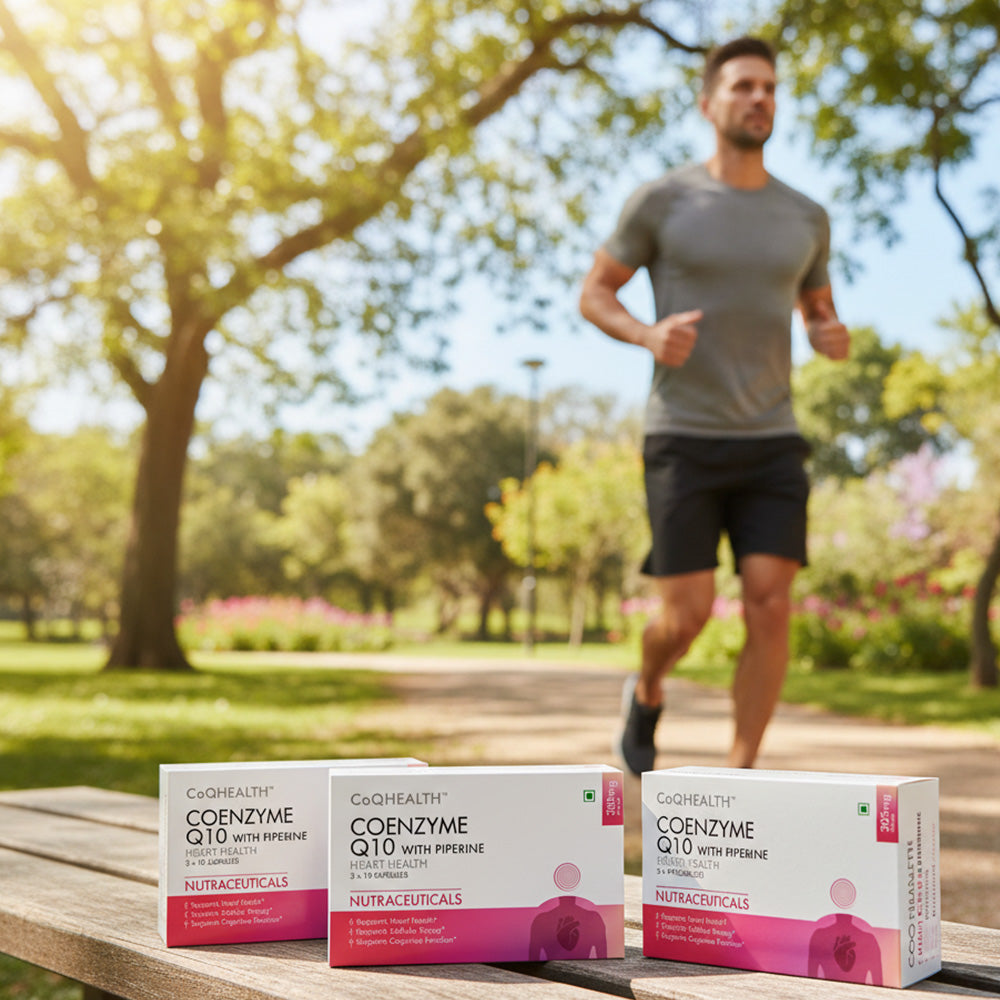
CoQHealth is designed around two clinically verified bioactives: 300 mg Coenzyme Q10 (Ubiquinone) and 5 mg Piperine in a plant-based capsule. The composition leverages micro-encapsulation technology for improved stability and absorption, with rigorous allergen-free and GMP/ISO-certified standards.
Mechanistic Rationale
CoQ10 is pivotal in mitochondrial ATP synthesis—the fundamental source of cellular energy. Deficiency is associated with fatigue, cardiovascular dysfunction, and accelerated cellular aging. Clinical studies confirm that daily doses ranging from 100-1200 mg support improved physical performance, energy restoration, and cardiac resilience, especially when oral absorption is optimized.pmc.ncbi.nlm.nih+2
Clinical Data
- A randomized controlled trial with 300 mg CoQ10 daily for 3 months showed statistically significant fatigue reduction in subjects with fibromyalgia, indicating robust mitochondrial support.pmc.ncbi.nlm.nih
- Heart failure patients supplementing CoQ10 reported reduced cardiovascular mortality (9% CoQ10 group vs. 18% placebo, n=420), improved hospitalization rates, and enhanced exercise capacity in meta-analyses.sciencedirect+3
- Statin therapy, widely prescribed for dyslipidemia, is known to reduce CoQ10 plasma levels, correlating with increased fatigue and muscle symptoms.pmc.ncbi.nlm.nih+1
- Piperine (5 mg) co-administered with CoQ10 enhances plasma CoQ10 by 30–32%, reaching statistical significance (p=0.0348), a result confirmed through repeated controlled studies investigating absorption and pharmacokinetics in healthy adults.sciencedirect+3
Annotation Reference
- Testai L, et al. Coenzyme Q10: Clinical applications beyond ... PMC,2021.pmc.ncbi.nlm.nih
- Badmaev V, et al. “Piperine derived from black pepper increases the plasma levels ofcoenzyme Q10.” PubMed, 2000.pubmed.ncbi.nlm.nih+1
- Mortensen SA, et al. “The effect of CoQ10 on morbidity and mortality in chronic heart failure.” JACC Heart Fail, 2014.sciencedirect
- Nankivell M, et al. “Coenzyme Q10 and Cognition: A Review.” PMC, 2025.pmc.ncbi.nlm.nih
Cardiac Outcomes and Mitochondrial Restoration — CoQHealth’s Role in Cardiovascular Management
Clinical Need
Cardiovascular disease (CVD) and chronic fatigue are global health concerns often linked to mitochondrial dysfunction and oxidative stress. CoQ10 supplementation has demonstrated both symptomatic and laboratory improvements in these populations.
Key Clinical Trials
- In the Q-SYMBIO trial, 420 chronic heart failure patients randomized to CoQ10 (300 mg/day) exhibited a 42% decrease in cardiovascular events and nearly halved mortality over 2 years, relative to placebo.nmi+2
- Meta-analyses across 2,149 CVD patients showed significant improvement in exercise tolerance, ejection fraction, and total symptom burden with CoQ10 supplementation up to 600 mg/day.onlinelibrary.wiley+1
- Statin-induced depletion is now a recognized medical issue; supplemental CoQ10 restores plasma levels, alleviating symptoms of muscle pain and fatigue in intervention trials.sciencedirect+1
- Microvascular endpoints (arterial stiffness, blood pressure) also show consistent improvement following sustained CoQ10 administration, with reductions in inflammatory biomarkers (TNF-α, IL-6). pmc.ncbi.nlm.nih
Bioavailability and Piperine Advantage
- Piperine increases CoQ10 area under curve (AUC) by ~30% after 21 days of co-administration, facilitating improved plasma concentrations. Mechanisms include enhanced micelle formation and higher gastrointestinal blood flow.sciencedirect+3
- Clinical integration: Non-GMO, allergen-free ingredients and micro-encapsulation ensure stability and compliance among sensitive populations.
Annotation Reference
- Mortensen SA, et al. JACC Heart Fail, 2014.sciencedirect
- Elgar K, et al. “Coenzyme Q10: A Review of Clinical Use and Efficacy.” NMI Health,2021.nmi
- Badmaev V, et al. “Piperine derived from black pepper increases CoQ10 plasma levels.” PubMed, 2000.sciencedirect+1
- Testai L, et al. PMC, 2021.pmc.ncbi.nlm.nih
- Zaki NM, et al. “Strategies for oral delivery ...” TandFonline, 2016.tandfonline
CoQHealth and Cognitive Vitality — Evidence-Based Protection Against Age-Related Decline
Scientific Foundation
Cognitive decline, neurodegeneration, and age-associated fatigue are invariably linked to
mitochondrial failure and chronic oxidative injury. CoQ10 is one of the few nutrients with evidence supporting both neuronal protection and improved energy metabolism.
Key Evidence
- In elderly populations, CoQ10 supplementation (100–300 mg/day) resulted in reductions of chronic fatigue, improved motor performance, and mild benefits in neuropsychological scores in controlled studies; trials confirm increases in plasma CoQ10 and NADH-cytochrome c reductase activity.frontiersin+3
- Randomized controlled studies show higher cognitive scores (MoCA, frontal battery) in patients supplementing CoQ10, with notable improvements in mitochondrial biomarkers and functional activity in the hippocampus and cortex, supporting anti-aging effects.pubmed.ncbi.nlm.nih+2
- Mechanisms of benefit include increased neuronal ATP, antioxidative defense, improved cerebral blood flow, and reduction in inflammatory markers.frontiersin+1
- Trials are mixed regarding definitive cognitive improvement in advanced AD and PD, but trends in functional decline and fatigue consistently favor CoQ10, especially in mild impairment cohorts.jamanetwork+3
Safety and Formulation Advantages
- Long-term safety is proven, with minimal adverse effects documented even at high dose (up to 2400 mg/day) across clinical populations.jamanetwork+1
- Piperine in CoQHealth ensures optimal plasma concentrations, overcoming typical absorption barriers for poorly solubilized nutraceuticals.pubmed.ncbi.nlm.nih+2
Annotation Reference
- Stough C, et al. “CoQ 10 and Cognition: a review and study protocol.” Front Aging Neurosci, 2019.frontiersin
- Nankivell M, et al. “Coenzyme Q10 and Cognition: A Review.” PMC,2025.pubmed.ncbi.nlm.nih+1
- Testai L, et al. PMC, 2021.pmc.ncbi.nlm.nih
- Shults CW, et al. “High-dosage CoQ10 in PD.” JAMA Neurol, 2014.jamanetwork
- Badmaev V, et al. “Piperine and CoQ10 bioavailability.” PubMed, 2000.sciencedirect+1
These articles synthesize relevant clinical outcomes, mechanistic insights, and novel features provided by CoQHealth, emphasizing data-driven, evidence-rich reporting suitable for publication or medical education.
- https://pmc.ncbi.nlm.nih.gov/articles/PMC8156424/
- https://www.sciencedirect.com/science/article/abs/pii/S0955286399000741
- https://www.tandfonline.com/doi/full/10.3109/10717544.2014.993747
- https://www.sciencedirect.com/science/article/pii/S2213177914003369
- https://www.nmi.health/coenzyme-q10-a-review-of-clinical-use-and-efficacy/
- https://pmc.ncbi.nlm.nih.gov/articles/PMC12430131/
- https://onlinelibrary.wiley.com/doi/10.1002/mnfr.70019
- https://pubmed.ncbi.nlm.nih.gov/10715596/
- https://www.sciencedirect.com/science/article/abs/pii/S0268005X20311243
- https://www.frontiersin.org/articles/10.3389/fnagi.2019.00103/full
- https://pubmed.ncbi.nlm.nih.gov/40944284/
- https://jamanetwork.com/journals/jamaneurology/fullarticle/1851409
- https://www.news-medical.net/news/20250909/Experts-review-the-evidence-on-coenzyme-Q10-and-cognitive-decline.aspx
- https://www.clinicaltrials.gov/study/NCT00243932
- https://www.thelancet.com/journals/lanepe/article/PIIS2666-7762(22)00235-6/fulltext
- https://clinicaltrials.gov/study/NCT02407548
- https://pmc.ncbi.nlm.nih.gov/articles/PMC3634921/
- https://jddtonline.info/index.php/jddt/article/view/5781/5340
- https://www.sciencedirect.com/science/article/pii/S0022316622068109
- https://www.ijpsonline.com/articles/development-and-validation-by-reverse-phase-high-performance-liquid-chromatography-method-for-the-estimation-of-piperine-and-coenz-4389.html?view=mobile