Cardiac muscle is among the most metabolically demanding tissue in the human body, consuming a disproportionate share of the body's oxygen even at rest. Sustaining continuous contraction requires relentless mitochondrial ATP production. Coenzyme Q10 (CoQ10) sits at the centre of that process, functioning both as an electron carrier in the mitochondrial respiratory chain and as a lipid-soluble antioxidant. For adults looking to support cardiovascular wellness through nutrition, CoQ10 is among the most studied options available.
The Heart's Energy Demands
Because cardiac tissue depends so heavily on mitochondrial output, the compounds involved in that pathway have attracted sustained research attention. CoQ10 is required for electron transfer between complexes I, II and III of the respiratory chain, and it also protects mitochondrial membranes from oxidative damage (Littarru GP, Tiano L. Curr Opin Clin Nutr Metab Care. 2005;8(6):641-6).
Everyday oxidative stress — from poor sleep, processed diets, low activity and environmental exposure — places ongoing demand on the body's antioxidant systems. Supplementing with coenzyme Q10 capsules is one nutritional approach to supporting those systems.
Why Levels Fall With Age
CoQ10 is synthesised endogenously via the mevalonate pathway. Production peaks in early adulthood and declines steadily thereafter, with the largest relative falls observed in tissues with high energy turnover. This age-related decline is the primary rationale for supplementation in adults over 40.
Some prescription medications act on the same biosynthetic pathway and can reduce the body's own CoQ10 production. If you take any prescription medication, particularly for cholesterol, discuss CoQ10 supplementation with your doctor before starting.
Absorption Is the Limiting Factor
CoQ10 is a large, fat-soluble molecule with limited natural bioavailability. Research consistently indicates that absorption, rather than dose, is the primary constraint on plasma levels achieved through oral supplementation (Bhagavan HN, Chopra RK. Coenzyme Q10: absorption, tissue uptake, metabolism and pharmacokinetics. Free Radic Res. 2006;40(5):445-53).
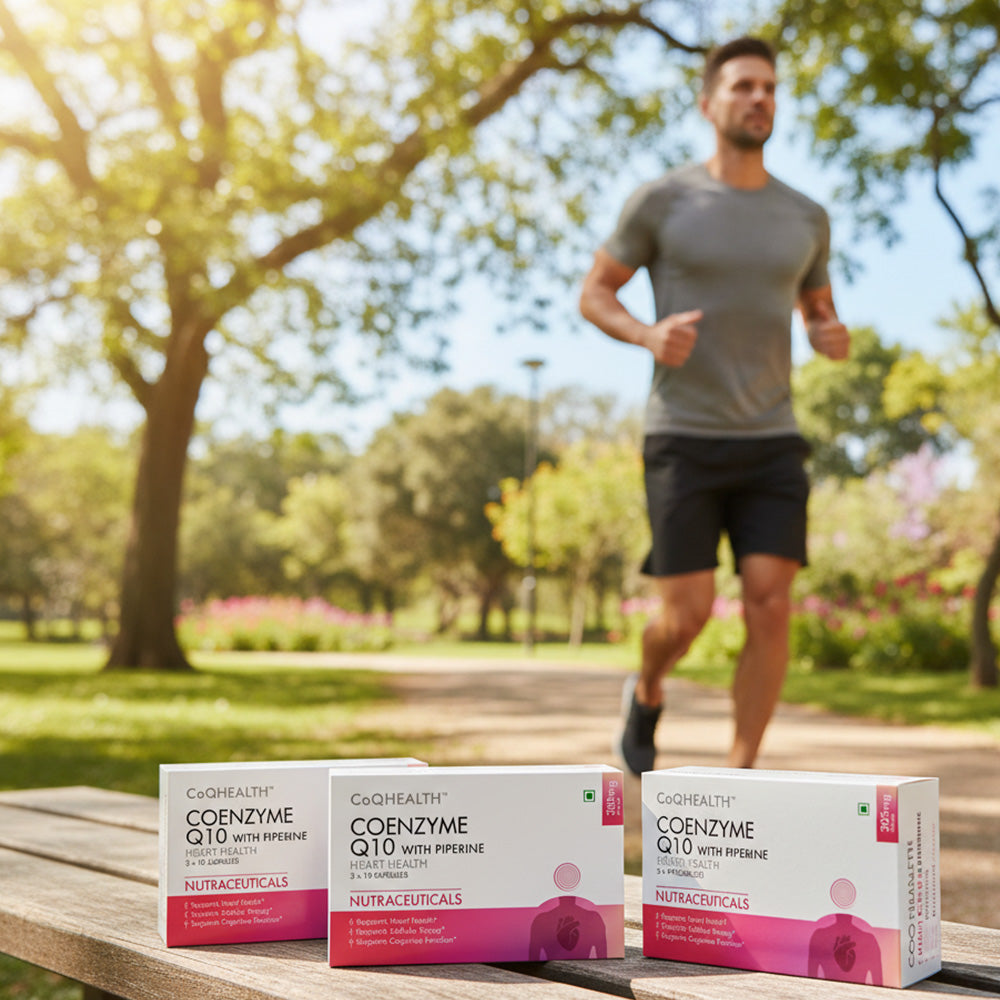
Piperine, an extract of black pepper, has been studied specifically for its effect on CoQ10 plasma levels following oral supplementation (Badmaev V, Majeed M, Prakash L. J Nutr Biochem. 2000;11(2):109-13). This is why CoQHealth includes it.
The CoQHealth Formulation
CoQHealth provides 300 mg of CoQ10 with 5 mg piperine, formulated for absorption rather than dose alone. It is best taken with a meal containing healthy fats, which further supports uptake of this fat-soluble nutrient. It is manufactured in a GMP and ISO certified facility, FSSAI licensed, and third-party tested for potency and purity.
What It Is Formulated to Support
CoQHealth is intended to support cellular energy production, cardiovascular wellness and antioxidant defence as part of a balanced lifestyle. Many users report changes in everyday energy and stamina within three to four weeks of consistent use, though individual experience varies considerably with age, diet and activity levels.
In summary: CoQ10 is a well-researched nutrient with a clear biological role in mitochondrial energy production. CoQHealth is formulated to deliver it in an absorbable form for adults wanting nutritional support for energy and cardiovascular wellness.
Further Reading
- Littarru GP, Tiano L. Bioenergetic and antioxidant properties of coenzyme Q10. Curr Opin Clin Nutr Metab Care. 2005;8(6):641-6.
- Bhagavan HN, Chopra RK. Coenzyme Q10: absorption, tissue uptake, metabolism and pharmacokinetics. Free Radic Res. 2006;40(5):445-53.
- Badmaev V, Majeed M, Prakash L. Piperine derived from black pepper increases the plasma levels of coenzyme Q10 following oral supplementation. J Nutr Biochem. 2000;11(2):109-13.
CoQHealth is a food supplement and is not intended to diagnose, treat, cure or prevent any disease. It is not a substitute for prescribed medication or medical care. Individual results vary.