Medically reviewed by Dr. Reina Punj, MBBS, PG Diploma in Endocrinology (University of South Wales), Lead Physician, Excelgenics Clinical Panel.
The Energy Factories Inside Your Cells
Still low on energy despite eating and sleeping well? Tiredness has many causes, including iron and thyroid problems, so persistent fatigue is worth discussing with your doctor. Part of the story of everyday energy, though, lies in your mitochondria.
Mitochondria are your cells' energy factories. One molecule that helps them run is coenzyme Q10 (CoQ10), a nutrient involved in cellular respiration in tissues including the heart, muscles and brain.
What is CoQ10 and Why Does It Matter?

CoQ10 is a vitamin-like compound made by the body and found in almost every cell. It sits in the inner membrane of the mitochondria, where it helps convert nutrients into adenosine triphosphate (ATP), the body's main energy currency.
It also:
- Acts as a fat-soluble antioxidant, helping to protect cell membranes from oxidative damage
- Carries electrons within the electron transport chain (ETC)
- Helps regenerate vitamin E, another membrane antioxidant
- Is found in higher concentrations in high-demand tissues such as the heart, kidneys, liver and muscles
This dual role is reviewed in Littarru and Tiano (2007).
Who Might Consider CoQ10?
Studies of human tissues have found lower CoQ10 levels in several organs in older age groups. People who sometimes consider CoQ10 include:
- Adults over 40
- People taking statins, which act on the same pathway the body uses to make CoQ10 (speak to your doctor first)
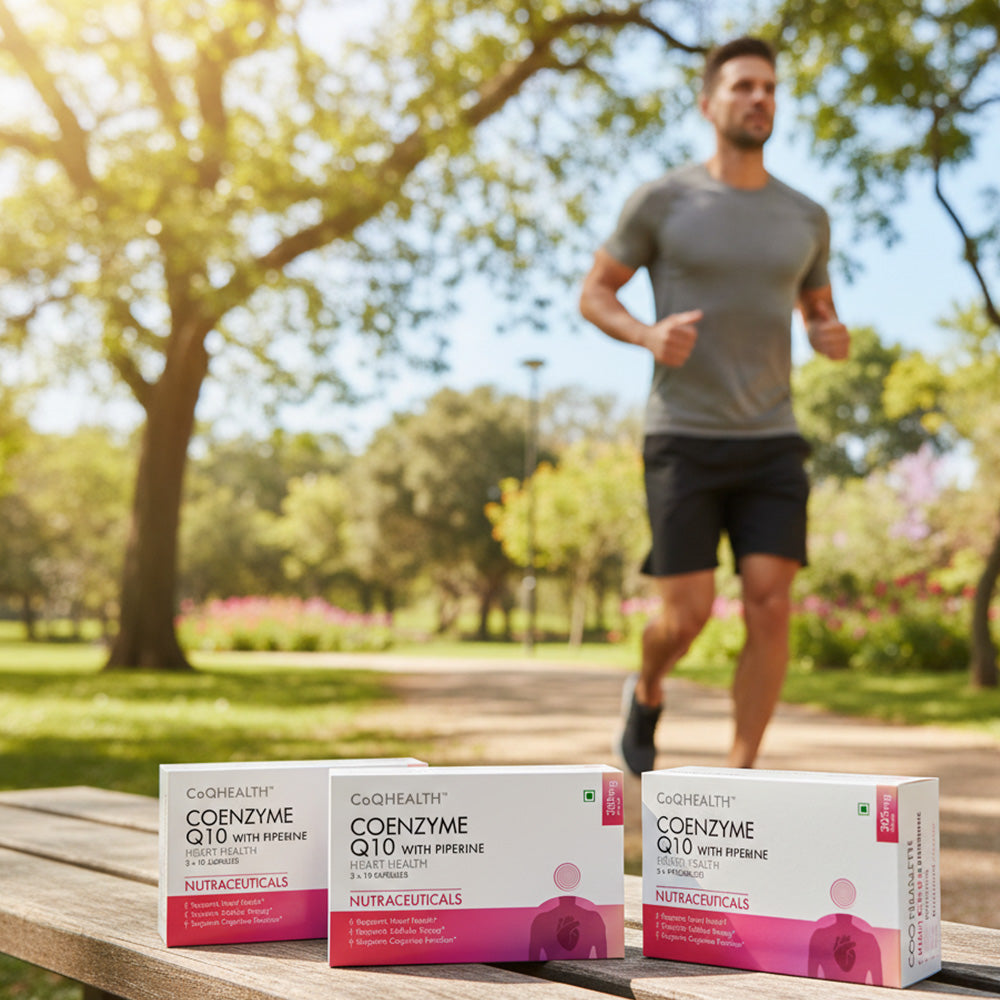
CoQHealth: CoQ10 with Piperine
CoQ10 on its own is poorly absorbed. CoQHealth by Excelgenics provides:
- 300 mg coenzyme Q10 (ubiquinone) per capsule
- 5 mg piperine from black pepper per capsule, included to help absorption
- A plant-based capsule
In one small study in healthy men, adding 5 mg of piperine to 120 mg of CoQ10 daily for 21 days raised plasma CoQ10 about 30% more than CoQ10 with placebo (Badmaev et al., 2000). The study was small, company-run and unreplicated.
What CoQ10 Research Has Found

CoQ10 has been studied in a range of areas, with mixed results:
- Heart failure: the Q-SYMBIO trial gave 420 patients with moderate to severe chronic heart failure 300 mg a day or placebo, alongside usual treatment, for two years. Major adverse cardiovascular events were 15% versus 26% and deaths from any cause 10% versus 18%, though short-term symptom measures did not change significantly. It is a single trial that has not been repeated. A 2021 Cochrane review judged that CoQ10 probably reduces deaths and heart-failure hospital admissions (moderate-quality evidence), but concluded there is currently no convincing evidence to support or refute its use for heart failure.
- Blood pressure: current evidence suggests CoQ10 probably does not have a meaningful effect (US National Center for Complementary and Integrative Health).
- Statin-related muscle symptoms: meta-analyses conflict, with one finding no significant benefit (Banach et al., 2015) and a later one some improvement (Qu et al., 2018).
These are research findings, not evidence that CoQHealth or any supplement prevents or treats disease.
When to Take CoQHealth
- Dosage: 1 capsule (300 mg CoQ10) daily with a meal containing healthy fats
- Best timing: morning or lunch
- Safety: CoQ10 may interact with warfarin and insulin, and piperine can change how the body metabolises some medicines. Mild digestive upset and trouble sleeping have been reported. Check with your doctor first if you take any medication.
Energy Isn't a Feeling. It's a Molecule.
At the cellular level, everyday energy depends on molecules such as CoQ10. CoQHealth by Excelgenics pairs 300 mg of CoQ10 with piperine to support normal cellular energy production as part of a balanced lifestyle.
CoQHealth. Support your mitochondria, every day.
References
- Littarru GP, Tiano L. Bioenergetic and antioxidant properties of coenzyme Q10: recent developments. Molecular Biotechnology. 2007;37(1):31–37. doi:10.1007/s12033-007-0052-y
- Kalén A, Appelkvist EL, Dallner G. Age-related changes in the lipid compositions of rat and human tissues. Lipids. 1989;24(7):579–584. doi:10.1007/BF02535072
- Banach M, Serban C, Sahebkar A, et al. Effects of coenzyme Q10 on statin-induced myopathy: a meta-analysis of randomized controlled trials. Mayo Clinic Proceedings. 2015;90(1):24–34. doi:10.1016/j.mayocp.2014.08.021
- Qu H, Guo M, Chai H, et al. Effects of coenzyme Q10 on statin-induced myopathy: an updated meta-analysis of randomized controlled trials. Journal of the American Heart Association. 2018;7(19):e009835. doi:10.1161/JAHA.118.009835
- Badmaev V, Majeed M, Prakash L. Piperine derived from black pepper increases the plasma levels of coenzyme Q10 following oral supplementation. Journal of Nutritional Biochemistry. 2000;11(2):109–113. doi:10.1016/S0955-2863(99)00074-1
- Mortensen SA, Rosenfeldt F, Kumar A, et al. The effect of coenzyme Q10 on morbidity and mortality in chronic heart failure: results from Q-SYMBIO. JACC: Heart Failure. 2014;2(6):641–649. doi:10.1016/j.jchf.2014.06.008
- Al Saadi T, Assaf Y, Farwati M, et al. Coenzyme Q10 for heart failure. Cochrane Database of Systematic Reviews. 2021;2:CD008684. doi:10.1002/14651858.CD008684.pub3
- National Center for Complementary and Integrative Health. Coenzyme Q10. nccih.nih.gov/health/coenzyme-q10
This article is for general education and is not medical advice. Food supplements are not intended to diagnose, treat, cure or prevent any disease. Consult a qualified healthcare professional before starting any supplement, particularly if you are pregnant, breastfeeding, have a medical condition or take medication.