
Skin & Beauty
Looking for supplements for glowing skin? No supplement can guarantee it: daily sunscreen, sleep, a balanced diet and not smoking matter most. Some nutrients still play a part, for example vitamin C contributes to normal collagen formation for the normal function of skin. Read our Marine Collagen Supplements Guide before you choose.
Shop by health goal
Sort by
Medically reviewed by Dr. Reina Punj, MBBS, PG Diploma in Endocrinology (University of South Wales), Lead Physician, Excelgenics Clinical Panel.
Before skin supplements: what actually helps your skin
Skin supplements are popular, but the habits with the strongest evidence are not in a capsule. The American Academy of Dermatology recommends a broad-spectrum, water-resistant sunscreen of SPF 30 or higher, which helps guard against wrinkles and age spots caused by too much sun. Sleep, enough protein, fruit and vegetables, and not smoking also matter more than any supplement.
If you have acne, pigmentation, persistent dryness, rashes or sudden hair loss, see a dermatologist or doctor first. These can have medical causes that no supplement will address.
Common skin supplement ingredients: what the evidence shows
| Ingredient | What the evidence shows |
|---|---|
| Collagen peptides | Some trials report better skin hydration and elasticity with 2.5–10 g a day, but a 2025 meta-analysis found benefits mainly in industry-funded and lower-quality trials. |
| Hyaluronic acid (oral) | A 2025 meta-analysis of 7 small trials reported better hydration and elasticity; the authors called for larger, more robust studies. |
| Vitamin C | Contributes to normal collagen formation for the normal function of skin. Most people can get enough from fruit and vegetables. |
| Vitamin E | Contributes to the protection of cells from oxidative stress. High doses can increase bleeding risk with blood thinners. |
| Zinc | Contributes to the maintenance of normal skin. The adult upper limit is 40 mg a day. |
| Biotin | Deficiency is rare, and evidence for hair, skin and nails in healthy people is limited. |
| Omega-3 | Deficiency can cause rough, scaly skin, but deficiency is uncommon. High doses can interact with warfarin. |
| Astaxanthin, lycopene, grape seed | Astaxanthin has a few small trials; we found little good-quality skin research on lycopene or grape seed extract. |
Collagen and hyaluronic acid
The Myung and Park 2025 meta-analysis of 23 trials found that independent and higher-quality collagen trials showed no significant effect on hydration, elasticity or wrinkles. Oral hyaluronic acid research is encouraging but small. Read more in marine collagen benefits.
Vitamin C, vitamin E and zinc
These are the ingredients with recognised nutrient functions. Vitamin C, vitamin E and zinc contribute to the protection of cells from oxidative stress, and zinc contributes to the maintenance of normal skin. If you are considering vitamin C for skin supplements, remember that amla, guava, citrus and capsicum are rich sources. See collagen-rich foods for skin for an Indian food list.
Biotin in hair, nail and skin supplements
Biotin is common in hair, nail and skin supplements, yet the US National Institutes of Health says claims for hair, skin and nails are supported, at best, by a few case reports and small studies. High-dose biotin can also cause falsely high or falsely low results in some laboratory tests, and the US FDA advises doctors to ask patients about biotin. Tell your doctor if you take it before any blood test.
Antioxidant extracts
A 2021 astaxanthin meta-analysis found better skin moisture and elasticity, but not wrinkles, in a few small trials using 2–12 mg a day. The authors called the findings preliminary.
How to read a skin supplement label
- Check the dose, not just the ingredient list. A fraction of the researched amount may not act the same way. Amounts are often listed per serving of two or more capsules.
- Add up overlaps. If you take a multivitamin as well, total your zinc, vitamin E and vitamin C so you stay within safe limits.
- Check the source. Marine collagen comes from fish, so it is not vegetarian.
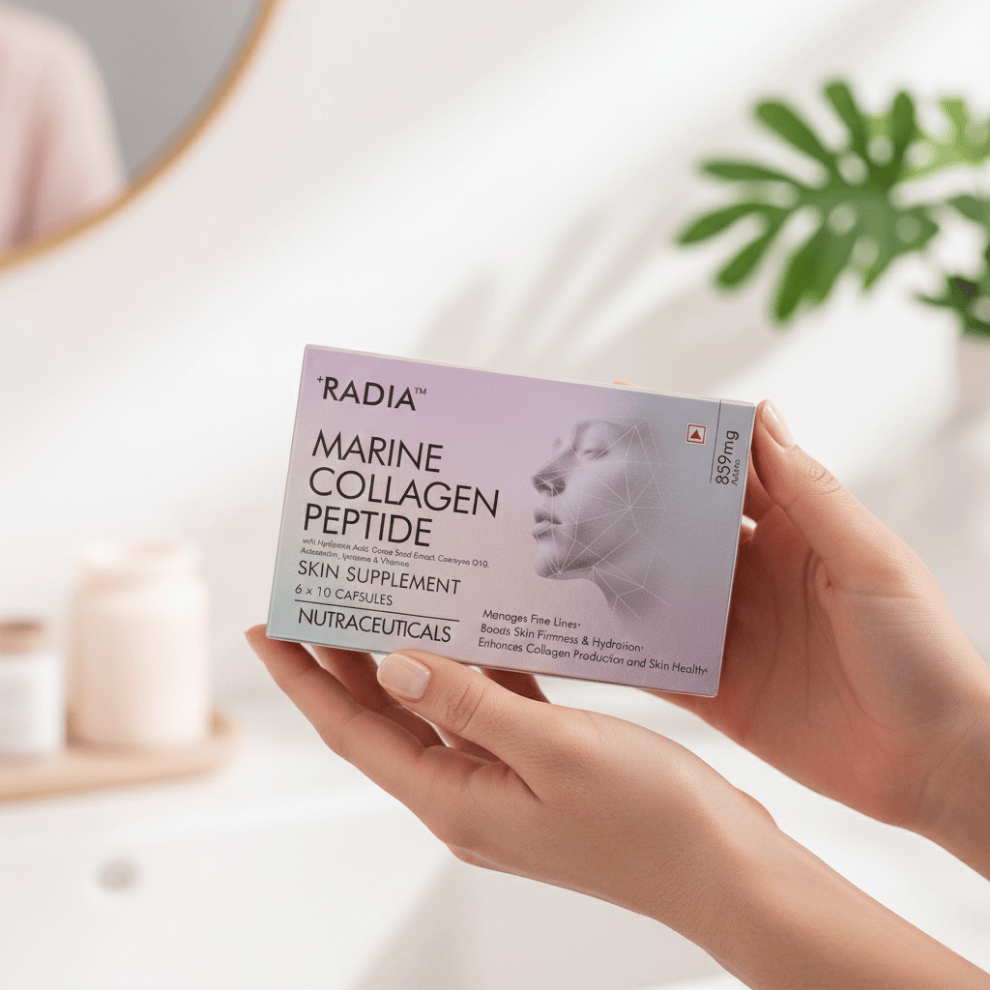
As an example, Radia Marine Collagen + Hyaluronic Acid provides 500 mg of marine collagen peptides (type I & III) per 2-capsule daily serving, with 100 mg low-molecular-weight hyaluronic acid, 100 mg grape seed extract (95% OPC), 65 mg vitamin C, 60 mg CoQ10, 10 mg lycopene, 10 mg vitamin E, 5 mg zinc, 5 mg black pepper extract and 4 mg astaxanthin. Its 500 mg of collagen is well below the 2.5–10 g used in most skin trials, so those trial results should not be assumed to apply. It is made under an FSSAI licence, and is taken as 2 capsules daily after a meal.
Supplements for glowing skin: realistic timelines
Skin renews slowly. Most collagen trials measured changes after 8–12 weeks of daily use, and astaxanthin trials ran from 4 to 16 weeks. Results vary, and some people notice no change. If you try a supplement, take it daily for two to three months, keep up sunscreen and diet, then judge honestly whether to continue.
Who should be careful with skin supplements?
- Fish allergy: avoid marine collagen.
- Pregnancy and breastfeeding: speak to your doctor before starting any supplement.
- Regular medicines: high doses of vitamin E or omega-3, and CoQ10, can interact with blood thinners such as warfarin; CoQ10 can also interact with insulin; black pepper extract (piperine) can change how some medicines are processed.
- Upcoming blood tests: tell your doctor about any biotin.
Radia is fish-derived and contains CoQ10 and black pepper extract, so it is not suitable for people with a fish allergy, and anyone taking regular medication should check with their doctor first. Read more in marine collagen side effects and our Marine Collagen Supplements Guide.
Frequently asked questions
Which supplement is best for glowing skin?
No supplement has been shown to guarantee glowing skin. Daily sunscreen, sleep, a balanced diet and not smoking matter most. If you choose a supplement, pick one with clearly stated amounts and realistic claims.
Do skin supplements really work?
Evidence is mixed. Some trials report modest changes in hydration or elasticity, but many are small or industry-funded.
Is vitamin C good for skin?
Vitamin C contributes to normal collagen formation for the normal function of skin. Most people can get enough from fruit and vegetables such as amla, guava and oranges.
Can I take biotin with a collagen supplement?
Usually, yes. Check labels for overlapping ingredients, and tell your doctor about biotin before any blood test.
How long do skin supplements take to work?
Most trials measured changes after 8–12 weeks of daily use. Results vary, and some people see no difference.
References
- Myung SK, Park Y. Effects of collagen supplements on skin aging: a systematic review and meta-analysis of randomized controlled trials. The American Journal of Medicine. 2025;138(9):1264–1277. doi:10.1016/j.amjmed.2025.04.034
- Amin P, Sarabi A, Choe S, Scott S, Suh S, Mesinkovska NA. Oral hyaluronic acid supplement: efficacy in skin hydration, elasticity, and wrinkle depth reduction. Journal of Drugs in Dermatology. 2025;24(9):910–919. doi:10.36849/jdd.8542
- Zhou X, Cao Q, Orfila C, Zhao J, Zhang L. Systematic review and meta-analysis on the effects of astaxanthin on human skin ageing. Nutrients. 2021;13(9):2917. doi:10.3390/nu13092917
- EFSA Panel on Dietetic Products, Nutrition and Allergies. Scientific Opinion on the substantiation of health claims related to vitamin C. EFSA Journal. 2009;7(10):1226. doi:10.2903/j.efsa.2009.1226
- NIH Office of Dietary Supplements. Biotin: fact sheet for health professionals. ods.od.nih.gov
- NIH Office of Dietary Supplements. Zinc: fact sheet for health professionals. ods.od.nih.gov
- NIH Office of Dietary Supplements. Vitamin E: fact sheet for health professionals. ods.od.nih.gov
- NIH Office of Dietary Supplements. Omega-3 fatty acids: fact sheet for consumers. ods.od.nih.gov
- National Center for Complementary and Integrative Health (NIH). Coenzyme Q10. nccih.nih.gov
- Bhardwaj RK, Glaeser H, Becquemont L, et al. Piperine, a major constituent of black pepper, inhibits human P-glycoprotein and CYP3A4. Journal of Pharmacology and Experimental Therapeutics. 2002;302(2):645–650. doi:10.1124/jpet.102.034728
- American Academy of Dermatology. Sunscreen FAQs. aad.org
This article is for general education and is not medical advice. Food supplements are not intended to diagnose, treat, cure or prevent any disease. Consult a qualified healthcare professional before starting any supplement, particularly if you are pregnant, breastfeeding, have a medical condition or take medication.





