CoQ10 Supplements: Benefits, Dosage and Which Form to Choose
Medically reviewed by Dr. Reina Punj, MBBS, PG Diploma in Endocrinology (University of South Wales), Lead Physician, Excelgenics Clinical Panel.
Coenzyme Q10 (CoQ10) is a fat-soluble compound that the body makes itself and uses in normal cellular energy production. It is also one of the more widely studied food supplements, especially among people who take statins. This guide explains what CoQ10 does, the difference between ubiquinone and ubiquinol, how much to take, what the research does and does not show, and who should be careful.
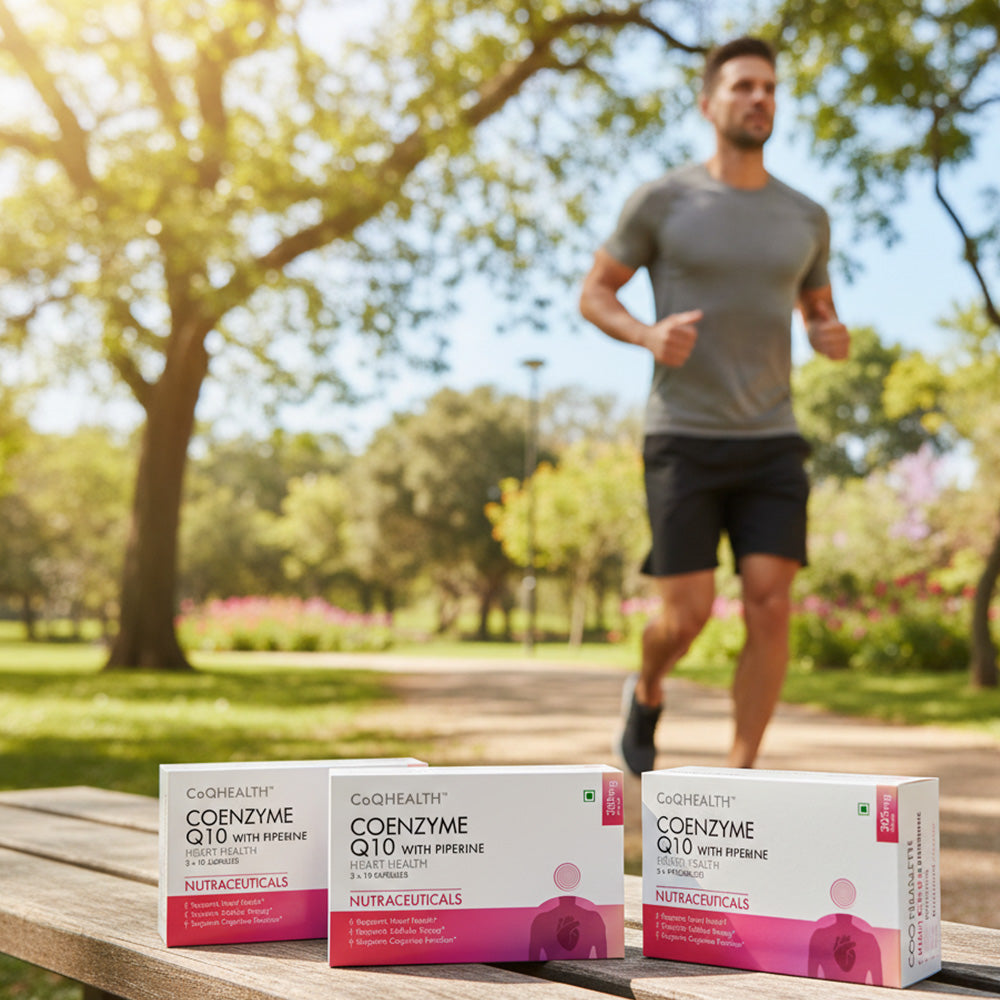
Shop CoQHealth CoQ10 300 mg with Piperine →
What is CoQ10?
CoQ10 is found in almost every cell. Inside the mitochondria, the parts of cells that turn food into usable energy, it carries electrons along the chain of reactions that produces ATP, the body's energy currency. It also acts as a fat-soluble antioxidant in cell membranes.
Because the body can make CoQ10, it is not classed as a vitamin, and there is no official recommended daily intake for it. Food provides only small amounts, estimated at about 3–6 mg a day in a typical diet, mainly from meat, fish and some oils. Post-mortem studies have found lower CoQ10 levels in several human organs in older age groups, and statins, the cholesterol-lowering medicines, lower the amount of CoQ10 circulating in the blood.
Ubiquinone vs ubiquinol: which form?
CoQ10 exists in two forms that the body switches between as it works. Supplements contain one or the other.
| Ubiquinone | Ubiquinol | |
|---|---|---|
| What it is | The oxidised form of CoQ10 | The reduced form of CoQ10 |
| In the body | Converted to ubiquinol after absorption; most CoQ10 in the blood is ubiquinol | Can be converted back to ubiquinone as CoQ10 does its job |
| On the label | Often listed simply as "coenzyme Q10" | Usually named as ubiquinol and marketed as "better absorbed" |
Is ubiquinol better? The evidence is mixed. A small study in 12 healthy volunteers found higher blood CoQ10 levels with 200 mg a day of ubiquinol than with the same dose of ubiquinone. A 2020 review argued the opposite: that the body readily converts ubiquinone to ubiquinol, and that how the CoQ10 is processed and formulated matters more than which form it is in. That review was written by employees of a company that sells ubiquinone, and the ubiquinol study was very small, so neither settles the question. For most people, the dose, taking it with food and consistency matter more than the form.
CoQHealth contains ubiquinone.
What to look for in a CoQ10 supplement
| What to check | Why it matters | CoQHealth |
|---|---|---|
| CoQ10 per serving | Typical supplements provide 30–100 mg. Trials in statin users have used 100–400 mg a day, and the main heart-failure trial used 300 mg. | 300 mg per capsule |
| Form | Labels should say whether they contain ubiquinone or ubiquinol. | Ubiquinone |
| Absorption aid | CoQ10 is poorly absorbed. Some products add an ingredient intended to help. | 5 mg piperine (black pepper extract) |
| Dosing guidance | CoQ10 is fat-soluble and is absorbed best with a meal that contains fat. | 1 capsule a day with a meal containing healthy fats |
| Suitable for vegetarians | Some softgels use gelatin. | Plant-based capsule |
Why absorption matters
CoQ10 is a large molecule that does not dissolve in water, so only a small fraction of an oral dose is absorbed, and blood levels do not rise in simple proportion to the dose. It needs dietary fat and bile to be taken up from the gut, which is why every CoQ10 label should tell you to take it with food.
Piperine, the main active compound in black pepper, has been studied as an absorption aid. In one small study in healthy men, 5 mg piperine with 120 mg CoQ10 daily for 21 days raised blood CoQ10 by about 30% more than CoQ10 alone; shorter experiments in the same study did not show a significant difference. The study was run by a company that sells piperine and has not been independently repeated. Piperine can also change how the body processes some medicines (see the safety section below).
CoQ10 benefits: what the research says
CoQ10 has a clear biological role in energy production. Whether taking it as a supplement makes a noticeable difference for healthy people is much less certain, and CoQ10 is not a stimulant. The best-studied areas are statin use and heart failure.
CoQ10 for statin users
Statins block an enzyme in the pathway the body uses to make both cholesterol and CoQ10. A 2018 meta-analysis of 12 randomised trials (1,776 participants) confirmed that statins lower blood CoQ10 levels. Some researchers think part of this fall simply reflects lower blood fats, which carry CoQ10 around the body.
Some people on statins report muscle aches, weakness or cramps, and CoQ10 has been tested for this many times with mixed results. A 2015 meta-analysis of 6 trials (302 patients) found no significant effect on muscle pain. A 2018 meta-analysis of 12 trials (575 patients) found that CoQ10 reduced reported muscle pain, weakness, cramps and tiredness compared with placebo, but did not change creatine kinase, a blood marker of muscle damage. The US National Center for Complementary and Integrative Health (NCCIH) concludes that, overall, the evidence does not support the idea that CoQ10 reduces statin-related muscle pain.
If you take a statin, keep taking it as prescribed. Muscle symptoms have many possible causes and need medical assessment, and unexplained muscle pain, weakness or dark urine should be reported to your doctor promptly. If you want to try CoQ10, agree it with your doctor first, partly because of the piperine point below.
Heart failure research
The best-known CoQ10 trial, Q-SYMBIO, gave 420 people with moderate to severe chronic heart failure 300 mg CoQ10 a day or placebo, alongside their usual treatment, for two years. Major adverse cardiovascular events occurred in 15% of the CoQ10 group compared with 26% on placebo. This single trial has not been repeated. A 2021 Cochrane review of 11 trials (1,573 participants) found moderate-quality evidence that CoQ10 probably reduces deaths and heart-failure hospital admissions, but the finding on deaths came from a single trial, and the authors said future trials are needed to confirm it. These are findings in patients under specialist care. They do not mean that CoQ10 or any supplement prevents or treats heart disease, and nobody should change heart medicines because of them.
CoQ10 dosage and how to take it
- Dose: follow the label. For CoQHealth, that is 1 capsule (300 mg) a day.
- Take it with fat: have it with a meal that contains some healthy fat, such as a meal cooked in oil or including nuts, seeds, curd or eggs.
- Best time to take CoQ10: morning or lunch. CoQ10 has occasionally been linked to trouble sleeping, so an evening dose may not suit everyone.
- Give it time: CoQ10 is not a quick-acting product. Most people take it daily for several weeks before judging whether it suits them.
- Count every source: some skin and multi-ingredient formulas also contain CoQ10. Radia, for example, contains 60 mg CoQ10 and 5 mg black pepper extract per daily serving, and is fish-derived, so it is not suitable for people with a fish allergy (see our Marine Collagen Supplements Guide).
CoQ10 side effects and safety
No serious side effects of CoQ10 have been reported in research. Mild digestive upset is the most common complaint, especially at doses of 200 mg a day or more, and some people notice trouble sleeping.
Speak to your doctor before taking a CoQ10 supplement if you:
- take warfarin or another blood thinner (CoQ10 has been reported to reduce the effect of warfarin, so blood tests may need closer monitoring);
- use insulin or other diabetes medicines;
- are having cancer treatment, as CoQ10 may not be compatible with some treatments;
- take a statin or any regular medicine: piperine has been shown to inhibit CYP3A4 and P-glycoprotein, which handle many medicines, including some statins;
- are pregnant.
Avoid CoQ10 supplements while breastfeeding, as there is too little reliable safety information.
Do not use CoQ10 as a reason to stop or reduce any prescribed medicine.
Who might consider a CoQ10 supplement?
- Adults who want nutritional support for normal cellular energy production as part of a healthy lifestyle
- People taking a statin who have discussed CoQ10 with their doctor
- Vegetarians who want a plant-based capsule (food sources of CoQ10 are mainly meat and fish)
If you are building a daily supplement routine, our guides to vegan omega-3 and magnesium supplements cover two other nutrients people often ask about.
Frequently asked questions
What is the best CoQ10 supplement in India?
There is no single best product. Look for a clearly stated dose in the range used in research, the form (ubiquinone or ubiquinol) named on the label, instructions to take it with food, and a full ingredient list. CoQHealth provides 300 mg ubiquinone with 5 mg piperine in one plant-based capsule and is made under an FSSAI licence.
Can I take CoQ10 with statins?
Many people do, but only with their doctor's agreement. The research on CoQ10 for statin muscle symptoms is mixed, and the piperine in some products may affect how certain statins are processed. Never stop or change a statin without medical advice.
Is 300 mg of CoQ10 too much?
Doses of 300 mg a day have been used in clinical trials, and studies suggest CoQ10 is well tolerated at up to 1,200 mg a day. Digestive upset is more common above 200 mg a day. Do not take more than the label dose.
Can I take CoQ10 every day?
Yes. CoQ10 supplements are designed for daily use at the dose on the label.
Do I need CoQ10 if I am under 40?
Not necessarily. The body makes its own CoQ10, and deficiency has not been described in the general population. A supplement is a personal choice, not a necessity.
Further reading
- CoQ10 uses: what it is, why people take it and what research shows
- CoQ10 foods: natural sources, vegetarian options and taking CoQ10 with food
- CoQ10 tablet uses in Hindi (हिंदी में)
See CoQHealth CoQ10 300 mg with Piperine →
References
- Linus Pauling Institute, Oregon State University. Coenzyme Q10. lpi.oregonstate.edu
- National Center for Complementary and Integrative Health (NIH). Coenzyme Q10. nccih.nih.gov
- Kalén A, Appelkvist EL, Dallner G. Age-related changes in the lipid compositions of rat and human tissues. Lipids. 1989;24(7):579–584. doi:10.1007/BF02535072
- Mantle D, Dybring A. Bioavailability of coenzyme Q10: an overview of the absorption process and subsequent metabolism. Antioxidants. 2020;9(5):386. doi:10.3390/antiox9050386
- Langsjoen PH, Langsjoen AM. Comparison study of plasma coenzyme Q10 levels in healthy subjects supplemented with ubiquinol versus ubiquinone. Clinical Pharmacology in Drug Development. 2014;3(1):13–17. doi:10.1002/cpdd.73
- Bhagavan HN, Chopra RK. Coenzyme Q10: absorption, tissue uptake, metabolism and pharmacokinetics. Free Radical Research. 2006;40(5):445–453. doi:10.1080/10715760600617843
- Badmaev V, Majeed M, Prakash L. Piperine derived from black pepper increases the plasma levels of coenzyme Q10 following oral supplementation. Journal of Nutritional Biochemistry. 2000;11(2):109–113. doi:10.1016/S0955-2863(99)00074-1
- Qu H, Meng YY, Chai H, et al. The effect of statin treatment on circulating coenzyme Q10 concentrations: an updated meta-analysis of randomized controlled trials. European Journal of Medical Research. 2018;23:57. doi:10.1186/s40001-018-0353-6
- Banach M, Serban C, Sahebkar A, et al. Effects of coenzyme Q10 on statin-induced myopathy: a meta-analysis of randomized controlled trials. Mayo Clinic Proceedings. 2015;90(1):24–34. doi:10.1016/j.mayocp.2014.08.021
- Qu H, Guo M, Chai H, et al. Effects of coenzyme Q10 on statin-induced myopathy: an updated meta-analysis of randomized controlled trials. Journal of the American Heart Association. 2018;7(19):e009835. doi:10.1161/JAHA.118.009835
- Mortensen SA, Rosenfeldt F, Kumar A, et al. The effect of coenzyme Q10 on morbidity and mortality in chronic heart failure: results from Q-SYMBIO. JACC: Heart Failure. 2014;2(6):641–649. doi:10.1016/j.jchf.2014.06.008
- Al Saadi T, Assaf Y, Farwati M, et al. Coenzyme Q10 for heart failure. Cochrane Database of Systematic Reviews. 2021;2:CD008684. doi:10.1002/14651858.CD008684.pub3
- Bhardwaj RK, Glaeser H, Becquemont L, et al. Piperine, a major constituent of black pepper, inhibits human P-glycoprotein and CYP3A4. Journal of Pharmacology and Experimental Therapeutics. 2002;302(2):645–650. doi:10.1124/jpet.102.034728
This information is for general education and is not medical advice. Food supplements are not intended to diagnose, treat, cure or prevent any disease. Consult a qualified healthcare professional before starting any supplement, particularly if you are pregnant, breastfeeding, have a medical condition or take medication.