Medically reviewed by Dr. Reina Punj, MBBS, PG Diploma in Endocrinology (University of South Wales), Lead Physician, Excelgenics Clinical Panel.
CoQ10 (coenzyme Q10) is a compound your body makes itself and uses to produce energy inside cells; it also works as an antioxidant that protects cell membranes. The main CoQ10 uses people ask about are as a supplement when taking statins (which lower blood CoQ10), as levels fall with age, and in research on heart failure and migraine, but for most of these uses the evidence is limited or mixed. This article explains what CoQ10 is used for, what studies have actually found, and who should be careful.
For dosage, forms and buying tips, see our full CoQ10 Supplements Guide.
CoQ10: what is it?
Coenzyme Q10 is a fat-soluble substance found in almost every cell, with the highest levels in the heart, liver, kidneys and pancreas. The body makes it from the same pathway it uses to make cholesterol. Because the body produces its own CoQ10, it is not classed as a vitamin, and there is no official recommended daily intake.
CoQ10 tablets, capsules and softgels all contain the same compound. The differences between products are the dose, the form (ubiquinone or ubiquinol) and what else is added.
What is CoQ10 used for in the body?

- Energy production. Inside mitochondria, the parts of cells that turn food into usable energy, CoQ10 plays a central role in making ATP, the body's energy currency.
- Antioxidant protection. CoQ10 acts as a fat-soluble antioxidant that helps protect cell membranes and blood fats (lipoproteins) from oxidation, and it helps regenerate vitamin E.
This biological role is well established. Whether taking extra CoQ10 as a supplement makes a noticeable difference for healthy people is a separate question, and the answer is much less certain.
CoQ10 tablet and capsule uses: why people take it
- Taking a statin. Statins lower the amount of CoQ10 circulating in the blood, so some people on statins choose to take it.
- Getting older. Tissue levels of CoQ10 have been found to decline with age.
- A vegetarian diet. Food provides only small amounts of CoQ10, mainly from meat, fish and some oils.
- General wellness. Some adults take it for nutritional support of normal cellular energy production as part of a healthy lifestyle.
CoQ10 uses and benefits: what the research says
The table below summarises what studies have found. These are research findings in the people studied. They are not claims for any supplement, and none of them means CoQ10 prevents or treats a disease.
| Area | What studies found | Strength of evidence |
|---|---|---|
| Statin users with muscle symptoms | Trials have had mixed results. The US National Center for Complementary and Integrative Health (NCCIH) concludes that, overall, the evidence does not support the idea that CoQ10 reduces statin-related muscle pain. | Not supported overall |
| Heart failure (patients under specialist care) | One large trial and a Cochrane review found possible benefits alongside standard treatment, but more trials are needed (see below). | Moderate for some outcomes; not confirmed |
| Migraine | A 2021 meta-analysis of 6 trials (371 adults) found fewer and shorter attacks than with placebo, but no change in how severe they were. | Low to moderate |
| Ageing and longevity | Levels fall with age, but there is limited evidence that supplements prolong life, and little evidence that they improve athletic performance. | Limited |
| Blood pressure | Limited evidence suggests it probably has no meaningful effect. | Limited |
Statins and CoQ10
Statins block an enzyme in the pathway that makes both cholesterol and CoQ10, and they lower blood CoQ10 levels. That explains the interest, but lower blood levels do not by themselves show that a supplement helps. If you take a statin, keep taking it as prescribed and report any unexplained muscle pain or weakness to your doctor. Our article on CoQ10 and statins covers the trials in more detail.
Heart failure research
The Q-SYMBIO trial gave 420 people with moderate to severe chronic heart failure 100 mg CoQ10 three times a day (300 mg a day) or placebo, on top of their usual treatment, for two years. Major adverse cardiovascular events occurred in 15% of the CoQ10 group and 26% of the placebo group. A 2021 Cochrane review of 11 trials (1,573 participants) found moderate-quality evidence that CoQ10 probably reduces deaths and heart-failure hospital admissions, but the result on deaths came from that single trial, and the authors concluded there is currently no convincing evidence to support or refute CoQ10 for heart failure. NCCIH also describes the heart-failure research as inconclusive. These findings are in patients under specialist care. Nobody should start, stop or change heart medicines because of them.
Migraine research
The 2021 migraine meta-analysis found about 1.5 fewer attacks a month on average, with attacks slightly shorter, and rated the overall evidence as low to moderate. NCCIH notes that the amount of evidence and the size of the effects were both small, so there are still uncertainties. Migraine needs medical assessment and treatment.
Ubiquinone vs ubiquinol
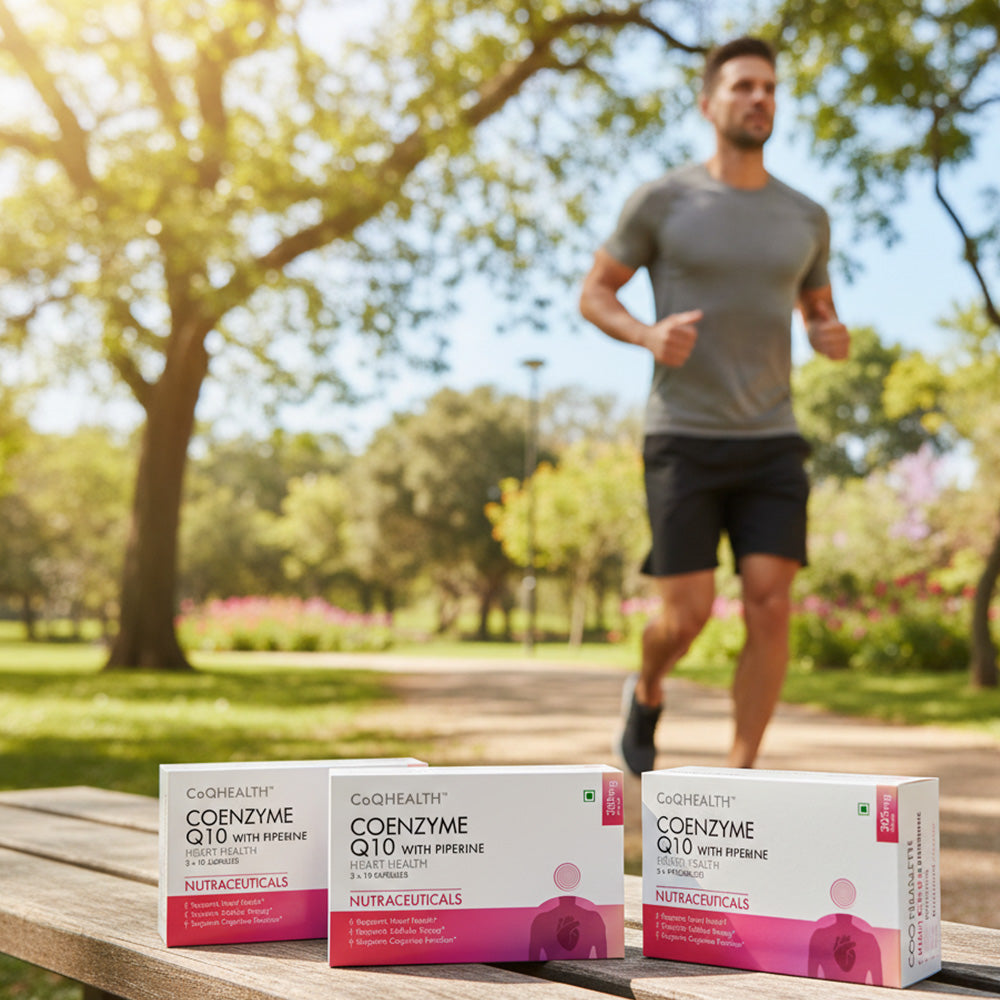
CoQ10 exists in two forms that the body switches between: ubiquinone (oxidised) and ubiquinol (reduced). Supplements contain one or the other, and the evidence on whether one is better absorbed is mixed. For most people, the dose, taking it with food and consistency matter more than the form. CoQHealth contains 300 mg ubiquinone with 5 mg piperine (black pepper extract) per plant-based capsule. Read more in ubiquinone vs ubiquinol: which form should you choose?
How to take CoQ10
- With a meal that contains fat. CoQ10 is fat-soluble and poorly absorbed; it is absorbed best with fat in a meal, such as food cooked in oil or including nuts, seeds, curd or eggs.
- Earlier in the day. Some people notice trouble sleeping with CoQ10, so a morning or lunchtime dose may suit better.
- Follow the label dose and be patient. CoQ10 is not a stimulant or a quick fix.
- Count every source. Some skin and multi-ingredient formulas also contain CoQ10.
Who should be careful with CoQ10
No serious side effects of CoQ10 have been reported in research. Mild digestive upset is the most common complaint, mainly at doses of 200 mg a day or more, and some people have trouble sleeping. Speak to your doctor first if you:
- take warfarin or another blood thinner: CoQ10 has reduced the effect of warfarin in a few cases, so clotting tests may need closer monitoring;
- use insulin or other diabetes medicines;
- are having cancer treatment, as CoQ10 may not be compatible with some treatments;
- are pregnant or breastfeeding: there is too little reliable safety information for breastfeeding, so CoQ10 is best avoided then;
- take any regular medicine and are choosing a product with piperine. Piperine has been shown to inhibit CYP3A4 and P-glycoprotein, which handle many medicines, so it can change how some drugs are processed. This applies to CoQHealth, which contains 5 mg piperine.
Never use CoQ10 as a reason to stop or reduce a prescribed medicine.
Frequently asked questions
What is CoQ10 used for?
In the body, CoQ10 helps cells make energy and acts as an antioxidant. As a supplement, people commonly take it when on statins, as they get older, or for general nutritional support. Research on specific conditions is limited or mixed.
Does CoQ10 give you energy?
CoQ10 has a role in normal cellular energy production, but it is not a stimulant, and there is little evidence that supplements improve energy or athletic performance in healthy people.
Should I take CoQ10 if I am on a statin?
Discuss it with your doctor first. NCCIH concludes that the evidence overall does not support CoQ10 for statin-related muscle pain, and piperine in some products may affect how certain medicines are processed.
Can I take CoQ10 every day?
Yes, CoQ10 supplements are designed for daily use at the dose on the label. Do not take more than the label dose.
References
- National Center for Complementary and Integrative Health (NIH). Coenzyme Q10. nccih.nih.gov
- National Center for Complementary and Integrative Health (NIH). Headaches and Complementary Health Approaches: What the Science Says (June 2023). nccih.nih.gov
- Linus Pauling Institute, Oregon State University. Coenzyme Q10. lpi.oregonstate.edu
- Mortensen SA, Rosenfeldt F, Kumar A, et al. The effect of coenzyme Q10 on morbidity and mortality in chronic heart failure: results from Q-SYMBIO: a randomized double-blind trial. JACC: Heart Failure. 2014;2(6):641–649. doi:10.1016/j.jchf.2014.06.008
- Al Saadi T, Assaf Y, Farwati M, et al. Coenzyme Q10 for heart failure. Cochrane Database of Systematic Reviews. 2021;2:CD008684. doi:10.1002/14651858.CD008684.pub3
- Sazali S, Badrin S, Norhayati MN, Idris NS. Coenzyme Q10 supplementation for prophylaxis in adult patients with migraine: a meta-analysis. BMJ Open. 2021;11(1):e039358. doi:10.1136/bmjopen-2020-039358
- Bhardwaj RK, Glaeser H, Becquemont L, et al. Piperine, a major constituent of black pepper, inhibits human P-glycoprotein and CYP3A4. Journal of Pharmacology and Experimental Therapeutics. 2002;302(2):645–650. doi:10.1124/jpet.102.034728
This article is for general education and is not medical advice. Food supplements are not intended to diagnose, treat, cure or prevent any disease. Consult a qualified healthcare professional before starting any supplement, particularly if you are pregnant, breastfeeding, have a medical condition or take medication.