Medically reviewed by Dr. Reina Punj, MBBS, PG Diploma in Endocrinology (University of South Wales), Lead Physician, Excelgenics Clinical Panel.
The Heart Runs on Energy
The heart beats roughly 100,000 times a day and is among the body's most metabolically active tissues. Much of that energy comes from mitochondria, which depend on a compound called coenzyme Q10 (CoQ10) as part of their electron transport chain.
Studies of human tissues have found lower CoQ10 levels in several organs, including the heart, in older age groups. This is one reason some adults over 40 consider CoQ10 as part of their nutrition.
What CoQ10 Does in the Body

Within the mitochondria, CoQ10 is involved in:
- Electron transport in the production of ATP, the body's energy currency
- Meeting the energy demands of continuously working muscle, including heart muscle
- Acting as a fat-soluble antioxidant within cell membranes
This dual role has made CoQ10 one of the more studied compounds in mitochondrial biology (Littarru and Tiano, 2007).
Why Levels Decline
The body makes CoQ10 through the mevalonate pathway. Levels in tissues appear to fall with age, and statins act on this same pathway; whether CoQ10 helps statin-related muscle symptoms is debated (Banach et al., 2015; Qu et al., 2018). If you take prescription medication, particularly for cholesterol, ask your doctor whether CoQ10 is appropriate for you.
What the Research Says

The best-known trial, Q-SYMBIO, gave 420 people with moderate to severe chronic heart failure 300 mg of CoQ10 a day or placebo, alongside usual treatment, for two years. Major adverse cardiovascular events were 15% versus 26%. It is a single, relatively small trial. A 2021 Cochrane review, whose mortality finding rests on this one trial, rated the evidence that CoQ10 probably reduces deaths and heart-failure hospital admissions in people with heart failure as moderate certainty, and said further trials are needed. These findings do not mean a supplement prevents or treats heart disease.
For Indians over 40, the foundations of cardiovascular wellness remain regular checks of blood pressure, blood sugar and cholesterol, physical activity, not smoking and a balanced diet. Supplements are no substitute.
Why CoQHealth Is Formulated This Way
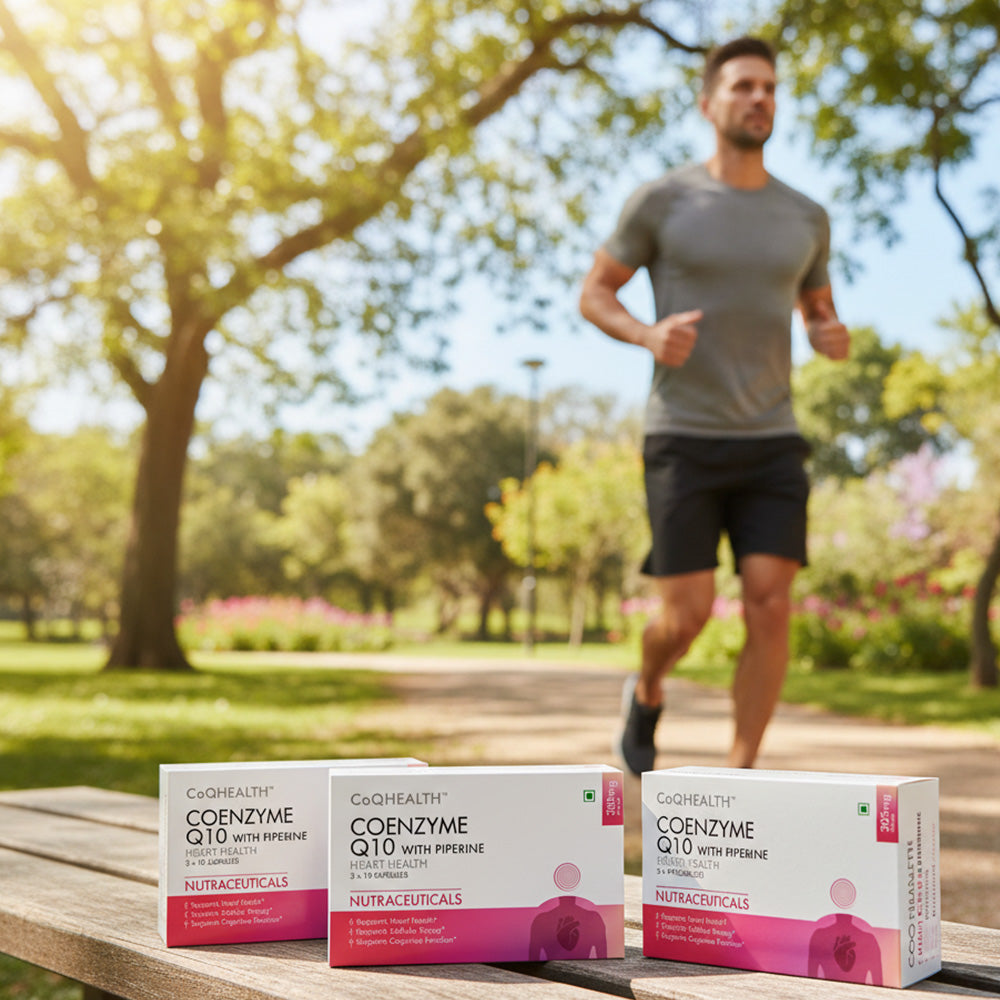
- 300 mg coenzyme Q10 (ubiquinone) per capsule
- 5 mg piperine per capsule, included to help absorption of this fat-soluble nutrient
- A plant-based capsule, taken once daily with a meal containing healthy fats (morning or lunch)
- Made under an FSSAI licence
What CoQHealth Is Formulated to Support

Normal cellular energy production and antioxidant activity within cell membranes, as part of a balanced lifestyle.
Who Might Consider It
- Adults over 40 interested in nutritional support for healthy ageing and energy
- Anyone whose doctor has suggested CoQ10 supplementation
CoQ10 may interact with the blood thinner warfarin and with insulin, and piperine can change how the body metabolises some medicines. Mild digestive upset and trouble sleeping have been reported. If you have a diagnosed heart condition or take any prescription medication, consult your doctor before use.
Absorption Matters as Much as Dose
CoQ10 is fat-soluble and poorly absorbed, and absorption does not rise in proportion to dose. CoQHealth pairs it with piperine, which modestly raised blood CoQ10 levels in one small study. It should be taken with a meal containing healthy fats.
References
- Kalén A, Appelkvist EL, Dallner G. Age-related changes in the lipid compositions of rat and human tissues. Lipids. 1989;24(7):579–584. doi:10.1007/BF02535072
- Littarru GP, Tiano L. Bioenergetic and antioxidant properties of coenzyme Q10: recent developments. Molecular Biotechnology. 2007;37(1):31–37. doi:10.1007/s12033-007-0052-y
- Banach M, Serban C, Sahebkar A, et al. Effects of coenzyme Q10 on statin-induced myopathy: a meta-analysis of randomized controlled trials. Mayo Clinic Proceedings. 2015;90(1):24–34. doi:10.1016/j.mayocp.2014.08.021
- Qu H, Guo M, Chai H, et al. Effects of coenzyme Q10 on statin-induced myopathy: an updated meta-analysis of randomized controlled trials. Journal of the American Heart Association. 2018;7(19):e009835. doi:10.1161/JAHA.118.009835
- Mortensen SA, Rosenfeldt F, Kumar A, et al. The effect of coenzyme Q10 on morbidity and mortality in chronic heart failure: results from Q-SYMBIO. JACC: Heart Failure. 2014;2(6):641–649. doi:10.1016/j.jchf.2014.06.008
- Al Saadi T, Assaf Y, Farwati M, et al. Coenzyme Q10 for heart failure. Cochrane Database of Systematic Reviews. 2021;2:CD008684. doi:10.1002/14651858.CD008684.pub3
- Badmaev V, Majeed M, Prakash L. Piperine derived from black pepper increases the plasma levels of coenzyme Q10 following oral supplementation. Journal of Nutritional Biochemistry. 2000;11(2):109–113. doi:10.1016/S0955-2863(99)00074-1
This article is for general education and is not medical advice. Food supplements are not intended to diagnose, treat, cure or prevent any disease. Consult a qualified healthcare professional before starting any supplement, particularly if you are pregnant, breastfeeding, have a medical condition or take medication.