Medically reviewed by Dr. Reina Punj, MBBS, PG Diploma in Endocrinology (University of South Wales), Lead Physician, Excelgenics Clinical Panel.
Boswellia serrata is a tree whose gum resin, known in India as shallaki or salai guggul and in English as Indian frankincense, has long been used in Ayurveda. Today, the main uses of Boswellia serrata are as a standardised extract in joint supplements, and the human research on its benefits focuses mostly on joint comfort in people with knee osteoarthritis: small trials show encouraging results, but larger, higher-quality studies are still needed. This guide explains what Boswellia serrata is, its common names, what the evidence shows, and who should be careful.
For how Boswellia compares with UC-II collagen, MSM and other joint ingredients, see our Joint Supplements Guide.
What is Boswellia serrata? Common names and source
Boswellia serrata is a branching tree native to mountainous regions of India, Northern Africa and the Middle East. When the trunk is cut, it releases a fragrant oleo-gum resin. That resin, rather than the leaves or fruit, is the part used in traditional medicine and in modern supplements.
The Boswellia serrata common name depends on where you are:
- Shallaki (Sallaki): the Sanskrit and Ayurvedic name.
- Salai guggul (or salai): a widely used Indian name for the tree and its resin.
- Indian frankincense or Indian olibanum: the usual English names. Frankincense used in incense and aromatherapy also comes from the resin of Boswellia trees.
Boswellic acids and AKBA: the compounds researchers study
The resin contains several boswellic acids, a group of compounds called pentacyclic triterpenic acids. The four main ones are β-boswellic acid, acetyl-β-boswellic acid, 11-keto-β-boswellic acid (KBA) and acetyl-11-keto-β-boswellic acid (AKBA). In laboratory studies, AKBA is the most potent of these at inhibiting 5-lipoxygenase, an enzyme involved in inflammation. These are laboratory findings and do not by themselves show what happens in the body.
Because raw resin varies, supplements use extracts standardised to a stated amount of boswellic acids, often to AKBA. When you compare products, look for both the extract amount and its standardisation on the label.
Traditional uses of Boswellia serrata
Shallaki has a long history in Ayurveda. The US National Center for Complementary and Integrative Health (NCCIH) notes that its traditional Ayurvedic uses include arthritis, inflammation and pain, as well as some respiratory and heart-related conditions. In India the resin has also been burnt as incense in religious ceremonies, and traditional preparations have been applied to the skin over aching joints. Traditional use tells us how a plant has been valued; it is not the same as evidence from controlled trials.
Boswellia serrata benefits: what human research shows
Most human trials of Boswellia serrata have been done in people with knee osteoarthritis, using pain, stiffness and function questionnaires.
- 2020 meta-analysis: a systematic review in BMC Complementary Medicine and Therapies pooled 7 randomised trials with 545 people with osteoarthritis. Compared with control treatments, Boswellia and its extracts were associated with less pain and stiffness and better joint function. The authors suggested using it for at least 4 weeks, but cautioned that the results should be interpreted carefully because of an unclear risk of bias and the small number of participants.
- 2014 Cochrane review: a Cochrane review of oral herbal products for osteoarthritis included five studies of three different Boswellia serrata extracts. In two studies with 85 participants, 100 mg a day of an enriched extract for 90 days gave a moderate-quality signal of a slight improvement in pain and function compared with placebo. No serious adverse events were reported.
- NCCIH summary: Boswellia taken by mouth may help reduce inflammation and pain linked to osteoarthritis, but larger, higher-quality studies are needed. Boswellia applied to the skin has not been shown to work for osteoarthritis.
These are findings in people with diagnosed osteoarthritis, often under medical care. They do not mean that Boswellia treats or prevents arthritis, and a supplement should not be expected to reproduce trial results.
The limits of the evidence
- Small and short: the trials included tens of people, not thousands, and usually lasted weeks to a few months.
- Different extracts: studies tested different branded extracts at different doses and standardisations, so results from one extract cannot simply be applied to another.
- Industry involvement: some trials were run with researchers from the companies that make the extract. For example, a 2010 trial of two branded extracts (60 participants, 100 mg a day for 90 days) was funded by the manufacturer and included three authors from its research centre.
Other uses being studied
Boswellia has also been studied for other uses, such as asthma. NCCIH says that most of this research is small and of low quality, and that there is not enough high-quality evidence to say whether Boswellia is useful for any health condition. If you have asthma or another diagnosed condition, do not use Boswellia in place of your prescribed treatment.
Boswellia serrata side effects and safety
NCCIH describes Boswellia as likely to be safe when taken by mouth: doses up to 1,000 mg a day have been used in trials lasting up to 6 months. The NIH LiverTox database describes side effects as few and largely mild and passing, mainly nausea, diarrhoea or constipation, and notes that in most controlled studies side effects were no more frequent than with placebo. A 2025 systematic review of 62 clinical trials found that the most common side effects were digestive upset and allergic skin reactions.
- Pregnancy and breastfeeding: little is known about the safety of medicinal doses, so avoid Boswellia supplements unless your doctor advises them.
- Blood thinners: Boswellia may increase the risk of bleeding with anticoagulant or antiplatelet medicines, although how significant this is in practice is not known. Ask your doctor first if you take one.
- Allergy: stop taking it and seek advice if you develop a rash or itching.
- Combination products: check every ingredient, not just the Boswellia.
How Boswellia serrata is used in supplements
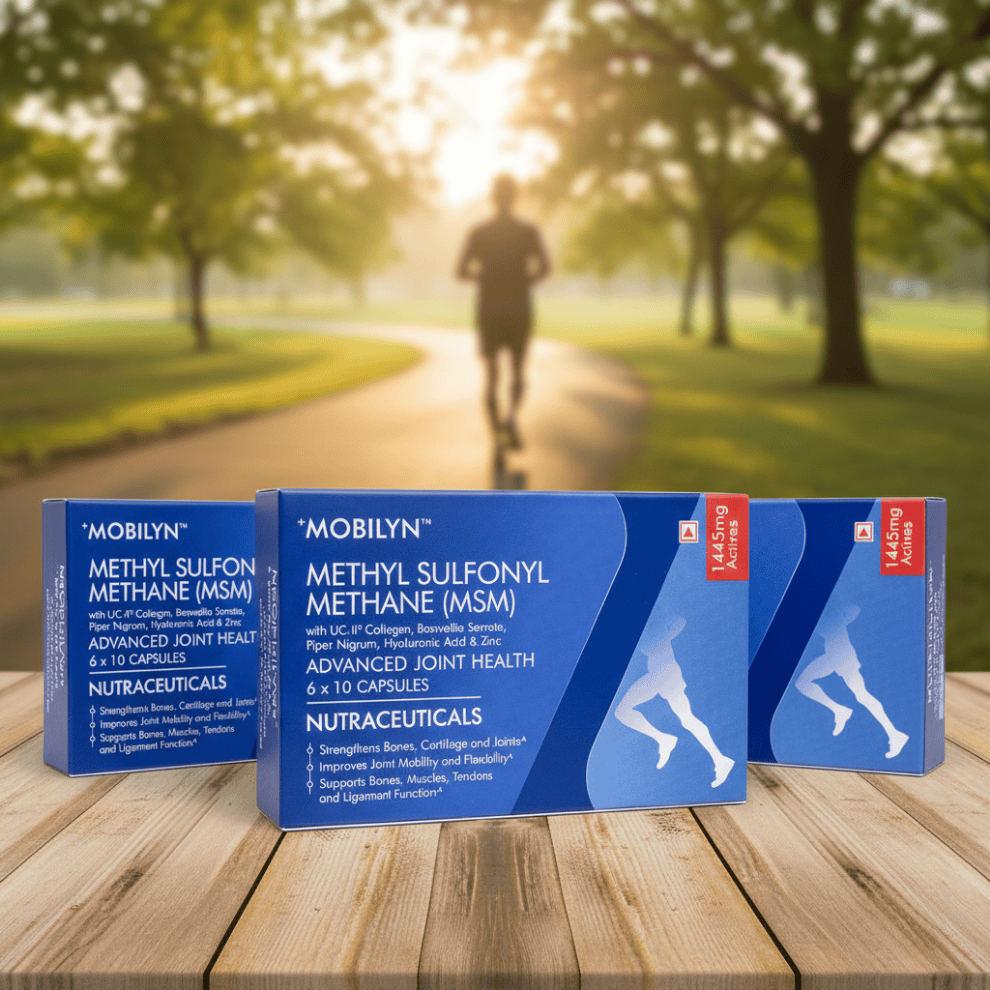
Boswellia is usually sold as capsules or tablets of standardised extract, either alone or combined with other joint ingredients. Mobilyn Joint Support with UC-II, MSM & Boswellia contains, per 2-capsule daily serving, Boswellia serrata extract (65% AKBA) 250 mg, MSM 1,000 mg, low-molecular-weight hyaluronic acid 80 mg, vitamin C 65 mg, UC-II undenatured type II collagen 40 mg, zinc 5 mg and black pepper extract (piperine) 5 mg. The dose is 2 capsules daily with water after meals (after breakfast or lunch). Because UC-II comes from chicken cartilage, it is non-vegetarian.
Piperine has been shown to inhibit CYP3A4 and P-glycoprotein, which handle many medicines, so it can change how some medicines are processed. Speak to your doctor or pharmacist before use if you take any regular medicine, including painkillers or blood thinners. No published trial has tested this particular combination; the research above relates to Boswellia extracts on their own.
A supplement is only one small part of looking after your joints. Regular, suitable exercise and a healthy weight matter more. To understand where everyday aches come from, read understanding everyday joint pain and what causes it, and see a doctor about joint pain, swelling or stiffness that lasts or keeps coming back.
Frequently asked questions
What is the common name of Boswellia serrata?
In India it is called shallaki (Sanskrit) or salai guggul, and in English Indian frankincense or Indian olibanum.
Is Boswellia the same as guggul?
No. Salai guggul is Boswellia serrata. "Guggul" on its own usually refers to the resin of a different tree, Commiphora wightii (also called Commiphora mukul). Check the Latin name on the label.
How long does Boswellia take to work?
Trials in people with knee osteoarthritis measured changes over periods from a few weeks to a few months, and the 2020 meta-analysis suggested using it for at least 4 weeks. Experiences vary, and some people notice no difference.
Can I take Boswellia every day?
In trials, Boswellia extracts were taken daily for up to 6 months and were generally well tolerated. Keep to the label dose, and speak to your doctor first if you are pregnant, breastfeeding or take regular medicines.
References
- National Center for Complementary and Integrative Health (NIH). Boswellia. nccih.nih.gov
- LiverTox: Clinical and Research Information on Drug-Induced Liver Injury. Boswellia serrata. National Institute of Diabetes and Digestive and Kidney Diseases; updated 2020. ncbi.nlm.nih.gov
- Siddiqui MZ. Boswellia serrata, a potential antiinflammatory agent: an overview. Indian Journal of Pharmaceutical Sciences. 2011;73(3):255. doi:10.4103/0250-474X.93507
- Yu G, Xiang W, Zhang T, Zeng L, Yang K, Li J. Effectiveness of Boswellia and Boswellia extract for osteoarthritis patients: a systematic review and meta-analysis. BMC Complementary Medicine and Therapies. 2020;20:225. doi:10.1186/s12906-020-02985-6
- Cameron M, Chrubasik S. Oral herbal therapies for treating osteoarthritis. Cochrane Database of Systematic Reviews. 2014;(5):CD002947. doi:10.1002/14651858.CD002947.pub2
- Sengupta K, Krishnaraju AV, Vishal AA, et al. Comparative efficacy and tolerability of 5-Loxin and Aflapin against osteoarthritis of the knee: a double blind, randomized, placebo controlled clinical study. International Journal of Medical Sciences. 2010;7(6):366–377. doi:10.7150/ijms.7.366
- Tavakoli A, Salehi Z, Amiri-Ardekani E, et al. Boswellia: a systematic review of the adverse events. Traditional and Integrative Medicine. 2025;10(3). doi:10.18502/tim.v10i3.19766
- Memorial Sloan Kettering Cancer Center. Boswellia (About Herbs). mskcc.org
- Bhardwaj RK, Glaeser H, Becquemont L, et al. Piperine, a major constituent of black pepper, inhibits human P-glycoprotein and CYP3A4. Journal of Pharmacology and Experimental Therapeutics. 2002;302(2):645–650. doi:10.1124/jpet.102.034728
This article is for general education and is not medical advice. Food supplements are not intended to diagnose, treat, cure or prevent any disease. Consult a qualified healthcare professional before starting any supplement, particularly if you are pregnant, breastfeeding, have a medical condition or take medication.