Medically reviewed by Dr. Reina Punj, MBBS, PG Diploma in Endocrinology (University of South Wales), Lead Physician, Excelgenics Clinical Panel.
Chia seeds vs flax seeds: spoon for spoon, they provide a similar amount of the plant omega-3 fat ALA, about 2.35–2.5 g per tablespoon. Chia has more fibre per spoon and can be eaten whole once soaked, while flaxseed (alsi) is the richest food source of lignans and is better eaten ground. Alsi is also grown in India and usually costs much less, so the right choice depends more on how you will use it than on any clear nutritional winner.
This guide compares chia seeds and flax seeds per tablespoon, explains whole vs ground, looks at cost and availability in India, and sets out safety points for each.
Chia seeds vs flax seeds: comparison table
| Per 1 level tbsp | Flaxseed, whole (alsi), about 10 g | Chia seeds, about 14 g |
|---|---|---|
| Energy | 55 kcal | 68 kcal |
| ALA (omega-3) | 2.35 g | 2.5 g |
| Dietary fibre | 2.8 g | 4.8 g |
| Protein | 1.9 g | 2.3 g |
| Calcium | 26 mg | 88 mg |
| Magnesium | 40 mg | 47 mg |
| Lignans | Richest dietary source: about 85 mg per 28 g | Not listed in standard lignan tables |
| How to eat | Ground (whole seeds may pass through undigested) | Whole or ground, soaked or mixed into moist food |
| In India | Grown in India; widely sold as alsi; lower cost | Newer crop in India; often imported; higher cost |
Nutrient amounts are from USDA FoodData Central (whole flaxseed, 1 tbsp = 10.3 g; dried chia seeds, 1 tbsp taken as 14 g). A chia tablespoon weighs more than a flax tablespoon, which is why chia looks slightly ahead on most rows. Gram for gram, flaxseed has more ALA (22.8 g vs 17.8 g per 100 g) and chia has more fibre (34.4 g vs 27.3 g per 100 g).
Omega-3 in chia and flax seeds

Both seeds are among the richest plant sources of alpha-linolenic acid (ALA), the essential omega-3 fat. One tablespoon of either provides more than the US adequate intake for ALA (1.1 g a day for women, 1.6 g for men) and is close to the 2.2 g of omega-3 fats a day that ICMR-NIN suggests for Indians.
Two points matter more than the small difference between them:
- ALA is not EPA or DHA. The body converts only a small share of ALA, reported at under 15%, into the longer-chain omega-3s found in fish. Neither seed is a like-for-like replacement for oily fish or algae oil. Our Vegan Omega-3 Supplements Guide explains this in more detail.
- Your cooking oil matters too. ALA competes with the omega-6 fat in oils such as sunflower and safflower for the same enzymes. See omega-3 vs omega-6 for how Indian cooking oils compare.
In Europe, ALA is authorised to be described as contributing to the maintenance of normal blood cholesterol levels, with the effect obtained from 2 g of ALA a day. A tablespoon of either seed provides about that much.
Fibre and lignans
Chia has more fibre per spoon, mainly insoluble fibre plus a gel-forming mucilage. Flaxseed also contains mucilage, which is why ground alsi thickens when mixed with water.
Flaxseed's distinctive feature is its lignans, plant compounds that gut bacteria convert into substances called enterolignans. The Linus Pauling Institute describes flaxseed as "by far the richest dietary source" of lignans, at about 85 mg per 28 g, compared with about 11 mg in the same weight of sesame seeds. Chia does not appear in its lignan table. Flaxseed oil does not provide lignans unless ground seed has been added.
Whole vs ground: how to eat chia and flax seeds

Flaxseed (alsi)
- Grind it. Whole flax seeds may pass through the gut undigested, and crushing or milling improves the availability of their lignans. Grinding small batches in a mixie works well.
- Roasting: many Indian homes dry-roast alsi before grinding it into a mukhwas or chutney powder. Do not eat raw or unripe flax seeds.
- Uses: stir 1 tbsp of ground alsi into atta for rotis or parathas, sprinkle it on poha, upma, dal or curd, or add it to laddoos and chikki.
Chia
- Soak it. Chia is absorbed well whole, so grinding is optional, but do not eat dry chia seeds on their own. Mix with liquid and leave for 15–20 minutes, or stir into a moist food such as curd.
- Uses: chia pudding with milk, overnight oats, smoothies, raita or nimbu pani.
For more on alsi itself, including roasted flax seeds and how much to eat, see our guide to flax seeds benefits.
Cost and availability in India
Flaxseed (linseed, alsi) is grown in India as an oilseed crop, mainly in Madhya Pradesh, Chhattisgarh, Uttar Pradesh and Maharashtra, and is easy to find in kirana shops as well as supermarkets. Chia is a newer crop here: researchers at CSIR-CFTRI in Mysuru began introducing it to local farmers in the mid-2010s, and much of the chia sold in cities has been imported.
When we compared prices at a large Indian online grocer in October 2026, flaxseed cost several times less than chia per 100 g. Prices vary by brand, city and season, but in general flaxseed is the cheaper way to add ALA to an Indian diet.
What does the research show?
Flaxseed has more human research than chia. A 2009 meta-analysis of 28 trials found small average reductions in total and LDL cholesterol among trial participants given whole flaxseed, but not flaxseed oil; the effects were clearer in people who started with higher cholesterol and in women. For chia, the Harvard T.H. Chan School of Public Health notes that controlled trials in humans have not shown a specific benefit on cardiovascular risk factors. Neither seed should be used to treat or prevent any condition, and anyone with high cholesterol should follow their doctor's advice.
Safety: who should be careful
- Drink enough water. Both seeds are high in fibre. Too much with too little water can cause bloating, gas or loose stools. Very large amounts of flaxseed (45–50 g a day) may cause diarrhoea.
- Swallowing or bowel problems: chia seeds eaten dry have blocked the food pipe in at least one reported case. If you have difficulty swallowing, a narrowed oesophagus or a history of bowel blockage, ask your doctor before eating either seed regularly.
- Blood thinners: flaxseed might interact with anticoagulant or antiplatelet medicines. Speak to your doctor if you take them.
- Pregnancy and breastfeeding: some studies suggest flaxseed in pregnancy is possibly unsafe, although the evidence is not conclusive, and little is known about its safety while breastfeeding. Avoid flaxseed supplements unless your doctor advises them, and ask before eating large amounts of the seed.
- Raw or unripe flaxseed: do not eat it, as it may contain potentially toxic compounds.
Chia seeds vs flax seeds: which should you choose?

- For the most ALA and lignans for your money: ground flaxseed (alsi). It fits easily into rotis, chutneys and dal.
- For more fibre per spoon and no grinding: chia, especially if you like chia pudding or soaked seeds in drinks.
- If you prefer drinks with seeds: chia or sabja both work. We compare them in sabja seeds vs chia seeds.
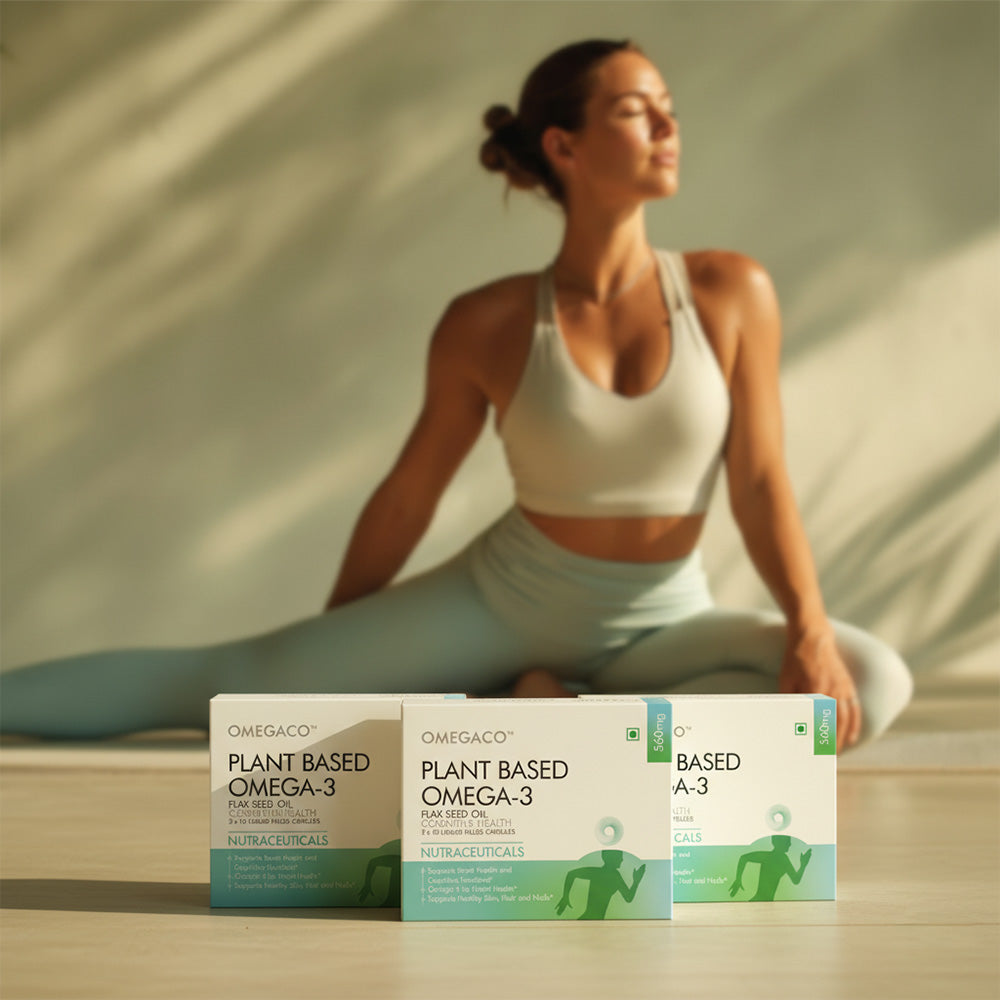
- If you do not enjoy either seed: a flaxseed oil capsule is a measured alternative for ALA, though it lacks the fibre and lignans. Omegaco provides 560 mg of cold-pressed flaxseed oil per capsule (an estimated ~300 mg ALA) and contains no EPA or DHA. Check with your doctor first if you take blood thinners or are pregnant or breastfeeding.
Using both seeds through the week is perfectly reasonable. ICMR-NIN's 2024 dietary guidelines suggest seeds such as flax and chia can be eaten at least three to four times a week.
Frequently asked questions
Which has more omega-3, chia or flax seeds?
Per tablespoon they are similar: about 2.35 g of ALA in whole flaxseed and about 2.5 g in chia. Gram for gram, flaxseed has slightly more.
Can I eat chia seeds and flax seeds together?
Yes. Many people mix ground alsi and soaked chia into curd or oats. Keep the total to a sensible food amount, such as 1–2 tablespoons a day, and drink enough water.
Should flax seeds be roasted or ground?
Grinding matters most, because whole seeds can pass through undigested. Light dry-roasting is a traditional way to improve flavour before grinding.
Are chia seeds better than flax seeds for vegetarians?
Neither is clearly better. Both are good vegetarian sources of ALA. Flaxseed is cheaper and widely grown in India; chia needs no grinding.
References
- US Department of Agriculture, FoodData Central. Seeds, flaxseed (SR Legacy, FDC ID 169414) and Seeds, chia seeds, dried (SR Legacy, FDC ID 170554). fdc.nal.usda.gov
- National Institutes of Health, Office of Dietary Supplements. Omega-3 Fatty Acids: Fact Sheet for Health Professionals. ods.od.nih.gov
- Harvard T.H. Chan School of Public Health, The Nutrition Source. Chia seeds. nutritionsource.hsph.harvard.edu
- Linus Pauling Institute, Oregon State University. Lignans. lpi.oregonstate.edu
- Pan A, Yu D, Demark-Wahnefried W, Franco OH, Lin X. Meta-analysis of the effects of flaxseed interventions on blood lipids. American Journal of Clinical Nutrition. 2009;90(2):288–297. doi:10.3945/ajcn.2009.27469
- Mayo Clinic. Flaxseed: Is ground better than whole? mayoclinic.org
- Kaiser Permanente Drug Encyclopedia. Flaxseed oral powder. healthy.kaiserpermanente.org
- National Center for Complementary and Integrative Health (NIH). Flaxseed and Flaxseed Oil. nccih.nih.gov
- ICMR-National Institute of Nutrition. Nutrient Requirements for Indians, 2020 (brief note). nin.res.in
- ICMR-National Institute of Nutrition. Dietary Guidelines for Indians, 2024. nin.res.in
- Commission Regulation (EU) No 432/2012, list of permitted health claims (alpha-linolenic acid). eur-lex.europa.eu
- Rawl RE. Watch it grow: esophageal impaction with chia seeds (abstract P643). American College of Gastroenterology Annual Scientific Meeting, 2014. gi.org
This article is for general education and is not medical advice. Food supplements are not intended to diagnose, treat, cure or prevent any disease. Consult a qualified healthcare professional before starting any supplement, particularly if you are pregnant, breastfeeding, have a medical condition or take medication.